
POD Profit Calculator
By using our calculators, you agree to our Terms of Use.
Profit per POD sale after base cost, printing, shipping, and marketplace fees.
Rates last reviewed: July 2026
Per-unit costs
Profit per sale
$10.55
Margin: 35.2%
- Total cost
- $19.44
- Platform fee
- $1.95
- Margin
- 35.2%
Related calculators
Print-on-demand margins
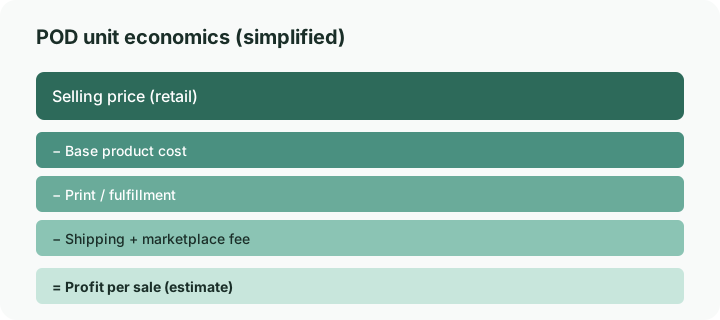
Print-on-demand sellers earn retail price minus every per-unit cost: blank product, print and fulfillment, shipping, and marketplace fees. Net profit = selling price − base cost − print cost − shipping − platform fee. Platform fees are typically a percentage of selling price on Etsy, Amazon Handmade, and similar channels, plus payment processing that may or may not be bundled in your fee input. Missing any line item inflates margin on paper while payouts disappoint.
POD margins look thin until you weigh them against zero inventory risk. You never buy 500 shirts upfront — each sale triggers fulfillment from a partner warehouse. That convenience costs more per unit than bulk screen printing, so successful POD shops price for margin after fees rather than racing to the lowest competitor price on identical designs. Volume without margin is just busy fulfillment; one refund can erase several small-profit orders.
Shipping strategy shapes economics as much as product cost. Many sellers offer "free shipping" by baking postage into the list price — enter shipping in costs even when the buyer sees free delivery. If the buyer pays shipping separately and you pass through carrier rates without markup, enter $0 shipping and set item price lower. Compare total checkout cost when researching competitors, not item line alone.
Design amortization is optional but real for artists. A graphic that took four hours to create might be spread across expected lifetime sales — add a per-unit design cost mentally even if this calculator focuses on fulfillment line items. One sale rarely covers creation time; catalogs of dozens of designs diversify that risk. Paid ad spend and listing fees are also per-sale or per-click costs outside this snapshot.
Compare POD providers on identical product specs before locking retail prices. A Gildan 5000 tee from Provider A versus B may differ $1 to $3 in base plus print, which is pure margin at the same retail price. Premium subscriptions like Printify Premium lower unit costs at the expense of a monthly fee — worthwhile only above a volume threshold where savings exceed the subscription. Re-quote when you switch blanks or print areas.
Returns and quality issues erode effective margin. A misprint replacement costs another fulfillment cycle without new revenue. Model a small refund rate by mentally reducing profit per sale or increasing variable costs. Customer acquisition cost from Meta or Etsy ads is separate — a $10 margin per shirt means little if you spent $8 in ads to get the order.
Worked example with defaults: base $8 + print $4.50 + shipping $4.99 = $17.49 hard costs. Sell at $29.99 with 6.5% platform fee ($1.95). Total cost ≈ $19.44. Profit ≈ $10.55 (~35% margin). One sale does not cover ad spend — factor marketing CAC separately. At 100 monthly orders, that margin yields about $1,055 before tax and overhead, not $2,999 gross revenue.
Planning estimates only — not tax advice. Report POD income and expenses per IRS self-employment rules on Schedule C or your entity return. Platform 1099-K reporting thresholds and sales tax nexus vary by state and order volume. Marketplace income is generally taxable even when you receive less than a 1099 — consult official IRS self-employment guidance or an accountant, not this page.
Use this when comparing providers or channels before you pick a dedicated TeePublic, Redbubble, or Printify tool. Enter every per-sale line item you actually pay.
Generic POD unit economics
| Base blank | Partner charge for the unprinted item |
| Print / fulfillment | Per-unit decoration and handling |
| Shipping | Postage you pay or include in list price |
| Platform fee | Marketplace percent on selling price |
Official sources
Rates and formulas in this calculator reference the documentation below. Confirm current numbers on the source site before relying on them. Links do not imply endorsement by those organizations of Calcometry or this tool.
Common questions
Which fees should I include?
Include every per-sale charge you pay: POD fulfillment base and print, shipping you subsidize, marketplace commission as a percent of price, and payment processing if not already inside the platform fee. Listing fees, off-site ads, chargebacks, and monthly shop subscriptions are extra — model high-fee scenarios separately if you run Etsy off-site ads or similar programs.
Should shipping be in the price or separate?
Many POD listings show free shipping with postage baked into item price — enter shipping in costs if you pay it. If the buyer pays shipping at checkout and you break even on postage, enter zero shipping and keep item price lower. Etsy search often favors free-shipping listings, which pushes sellers toward embedded shipping even when checkout psychology differs.
How do POD margins compare to holding inventory?
POD avoids upfront inventory risk and storage but per-unit cost is higher than bulk manufacturing. Bulk screen printing or wholesale blanks can yield better margins if you sell through stock reliably. This calculator models POD per-order economics — compare against inventory math separately before choosing a fulfillment model for a new product line.
Does this include Etsy off-site ads fees?
No — Etsy off-site ads can take up to 15% on qualifying orders in addition to standard transaction and processing fees. Model those orders separately or add a higher effective fee percent when a large share of sales comes from off-site traffic. Standard defaults use typical transaction fee rates only.
What margin should POD sellers target?
Many aim for 25% to 40% after all per-unit costs, higher on niche designs with less price competition. Cover ad spend, returns, and design time outside this per-sale snapshot. A $10 profit on a $30 shirt sounds healthy until $6 in ads and $2 in refunds land on the same order.