
BMI Calculator
By using our calculators, you agree to our Terms of Use.
Body mass index from height and weight. For screening only — not a diagnosis.
Rates last reviewed: July 2026
Height & weight
BMI
25.8
Overweight range
- Category (estimate)
- Overweight range
Related calculators
Body mass index
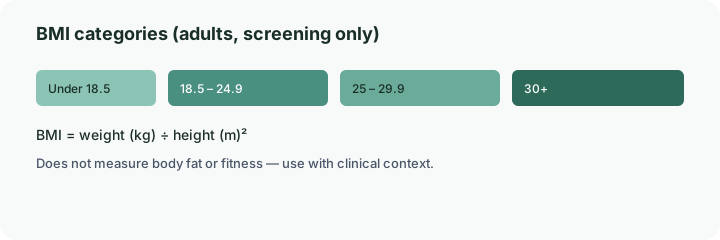
Body mass index (BMI) is a simple ratio of weight to height squared, designed as a population-level screening tool rather than a direct measure of body fat or fitness. In US customary units, BMI equals 703 multiplied by weight in pounds, divided by height in inches squared. In metric, BMI equals weight in kilograms divided by height in meters squared. The same person receives the same BMI regardless of which unit system you use, because the calculator converts internally before applying the formula.
The World Health Organization and CDC use standard adult cutoffs for screening: below 18.5 is classified as underweight, 18.5 to 24.9 as the normal range, 25.0 to 29.9 as overweight, and 30.0 or above as obesity. These bands describe statistical associations with health risks across large populations — they do not diagnose any individual condition. A single BMI number cannot tell you whether weight comes from muscle, bone density, or adipose tissue.
BMI cannot distinguish muscle from fat. A strength athlete with low body fat may land in the overweight category because dense muscle mass adds weight without the same metabolic risks as excess adipose tissue. Conversely, someone with normal BMI may carry unhealthy visceral fat with low muscle mass — a pattern sometimes called normal-weight obesity that BMI alone misses. Waist circumference and body composition testing add context that height-and-weight math cannot provide.
Age and sex are not part of the standard adult BMI formula, yet body composition shifts with aging — muscle loss and fat redistribution can change health risk at the same BMI number. Pediatric BMI uses age- and sex-specific growth charts, which this adult calculator does not apply. For children and teens, clinicians use CDC growth percentiles instead of fixed adult cutoffs. Older adults may benefit from discussing sarcopenia and bone health with a provider even when BMI looks normal.
Ethnic background also influences interpretation. Research cited by WHO suggests Asian populations may face elevated metabolic risk at lower BMI thresholds than European populations, leading some health agencies to propose adjusted cutoffs near 23 for overweight screening. Always discuss your result with a clinician who can weigh family history, waist circumference, blood pressure, lipid panels, and glucose alongside a BMI number rather than treating the index as a standalone verdict.
BMI is most useful as a starting conversation, not a finish line. CDC guidance recommends combining BMI screening with other measures — waist size, physical activity habits, diet quality, and blood pressure — when assessing weight-related health risk. If your BMI falls outside the normal band, a provider may order further tests before recommending any change. If it falls inside the band, that does not automatically mean all metabolic markers are optimal.
Worked example with default inputs: 170 lb at 5 ft 8 in (68 inches). BMI equals 703 times 170 divided by 4,624, which is approximately 25.8 — in the overweight screening band. Changing only weight to 155 lb drops BMI to about 23.5, inside the normal range, illustrating how sensitive BMI is to modest weight shifts at a fixed height. Switching to metric with 77.1 kg and 172.7 cm yields the same index after conversion.
This tool is for general wellness screening and education only. It is not medical advice and cannot diagnose obesity, eating disorders, malnutrition, or any other health condition. Do not start, stop, or change medication, diet, or exercise programs based solely on a BMI result. Consult a qualified healthcare provider who can interpret your full health picture before making treatment decisions.
Official sources
Rates and formulas in this calculator reference the documentation below. Confirm current numbers on the source site before relying on them. Links do not imply endorsement by those organizations of Calcometry or this tool.
Reference to CDC materials or links does not imply endorsement or recommendation by CDC, ATSDR, HHS, or the U.S. Government.
Common questions
Is BMI accurate for everyone?
No. BMI does not distinguish muscle from fat and may misclassify athletes, older adults, and some ethnic groups. Waist circumference, DEXA or bioelectrical impedance scans, and a clinical exam provide better individual context than height and weight alone. Treat BMI as one screening input, not a definitive body composition score.
Is this medical advice?
No. BMI is a screening estimate only. It cannot diagnose health conditions, prescribe weight targets, or replace an assessment from a qualified healthcare provider. If your result concerns you — whether high or low — schedule a visit rather than self-diagnosing from this page.
What BMI range is considered healthy for adults?
CDC and WHO screening guidelines use 18.5 to 24.9 as the normal range for adults aged 20 and older. Individual targets may differ based on muscle mass, age, pregnancy status, and medical history. Some Asian health authorities suggest lower overweight thresholds — ask your clinician which reference fits your background.
Should I use pounds or kilograms?
Either works — toggle the unit switcher and enter height and weight in matching units. The calculator converts internally and returns the same BMI. Default is US customary (lb, in). If you know your measurements in centimeters and kilograms, switch to metric before entering values to avoid manual conversion errors.
Can BMI predict my body fat percentage?
Not reliably at the individual level. BMI correlates with average body fat across large populations, but individual error is large — two people with identical BMI can have very different fat percentages. DEXA scans, hydrostatic weighing, or calibrated bioelectrical impedance estimate body fat more directly when a clinician orders them.